Can Art and Poetry Be Used to Change the Evils Within a Society Romantasism
Definition of Romanticism
Romanticism (also the Romantic era or the Romantic period) is an artistic, literary, and intellectual move that originated in Europe toward the end of the 18th century and was at its summit in the approximate period from 1800 to 1850.
Romanticism is characterized past its emphasis on emotion and individualism too as glorification of all the past and nature, preferring the medieval rather than the classical. It is a reaction to the ideas of the Industrial Revolution, the aloof social and political norms of the Age of Enlightenment, and the scientific rationalization of nature.
The meaning of romanticism has changed with time. In the 17th century, "romantic" meant imaginative or fictitious due to the nascency of a new literary genre : the novel. Novels, that is to say texts of fiction, were written in vernacular (romance languages), as opposed to religious texts written in Latin.
In the 18th century, romanticism is eclipsed by the Age of Enlightenment, where everything is perceived through the prism of science and reason.
In the 19th century, "romantic" ways sentimental : lyricism and the expression of personal emotions are emphasized. Feelings and sentiments are very much present in romantic works.
Thus, so many things are called romantic that it is difficult to meet the common points between the novels by Victor Hugo, the paintings by Eugène Delacroix or the music past Ludwig Von Beethoven.
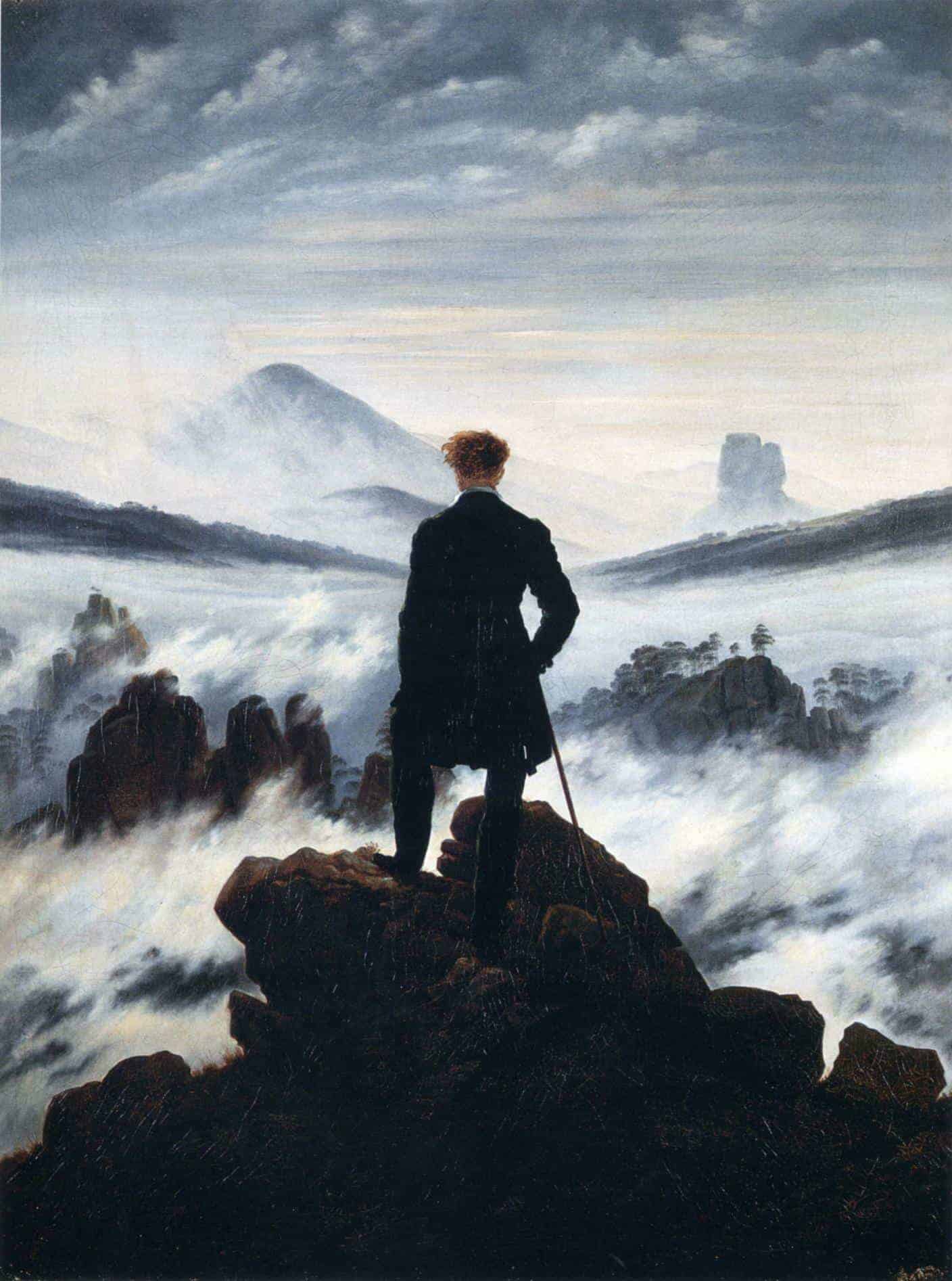
The romantic international
Romanticism is not limited to ane land, it was an international vision of the world.
The romantic international started in Germany at the finish of the 18th century with "Storm and Stress". The ii about famous poets are Goethe and Schiller and many philosophers such as Fichte, Schlegel, Schelling and Herder.
Romanticism was then adopted in England. Poets are divided in two generations :
- first generation : William Blake, William Wordsworth, Samuel Taylor Coleridge.
- second generation : George Byron, Percy Shelley, John Keats.
Romanticism reached France at the beginning of the 19th century with François-René de Chateaubriand – Atala (1801), René (1802), Le Génie du Christianisme (1802) – and Germaine de Staël : De l'Allemagne (1813).
Romanticism was a renewal, a revolution is artistic forms in paintings, literature and theatre. In Germany and Russia, romanticism created the national literature. It influenced the whole vision of art.
Information technology was also the origin of contemporary ideas : modern individualism, the vision of nature, the vision of the work of art as an isolated object.
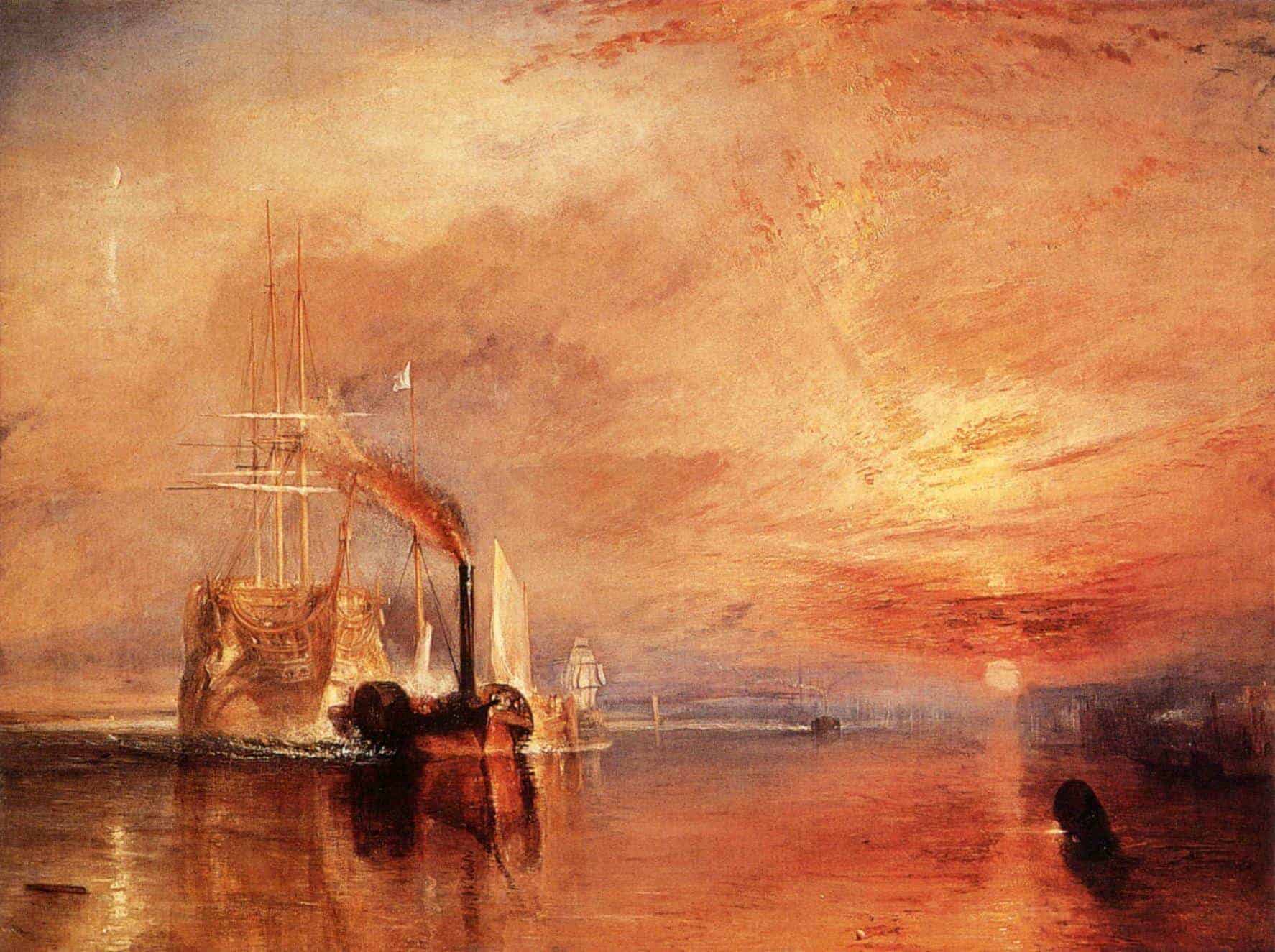
Political dimension : the birth of Romanticism
Romanticism represents a interruption with the universalistic outlook of the Enlightenment. Reason is something universal and the Enlightenment found its models in classical France and Rome : all men are the same because there are all reasonable. Romanticism if a fragmentation of consciousness, with no universalistic ideas left.
The French Revolution was characterized by universalistic ideas such every bit all men are created equal. It corresponds to the philosophy of the Enlightenment. The nation is born out of a social contract : it means that you are free to choose to belong to ane nation or another.
It is unlike in Germany where yous don't cull your country, that is where yous were born (organic nation).
In that location's a departure between the commencement and 2d generation of poets. British poets were rather progressive and shut to dissenters.
The French Revolution was full of hope of equality but it rapidly changed when in 1793, it gave style to the Terror and the beheading of the King.
The first generation of British romantic poets
Only William Blake remained a radical, unlike Wordsworth and Coleridge. There was an incredible pressure in England at the time. The Prime number Minister, Pitts, suspended the Habeas Corpus and adopted the Sedition Act, which was meant to prevent the freedom of press. It turned abroad the first generation from their ideals.
Blake wrote a visionary, imaginary poetry, actually hard to understand. Wordsworth and Coleridge were reactionary to the French Revolution.
Wordsworth turned abroad from the excesses of the revolution and wrote a simple poetry in a autonomous style.
Coleridge was inspired by the Center Ages and German thought and was a reactionary Christian nationalist.
The second generation of British romantic poets
The 2nd generation remains more radical but the political climate was then oppressive that the radicals left England or fabricated more indirect political comments.
The Mask of Anarchy by Shelley was inspired by the Peterloo Massacre of 1819. In Prometheus Unbound, a man fights against political and religious oppression.
Romanticism was continued with politics of the time. Romantic poets could be either conservative or progressive, depending on their vision of the world.
Main romantic themes
From society to nature
There is an intellectual shift from society to nature. During the Enlightenment, thinkers had a metropolitan consciousness: the intellectual life took identify in cities – London and Edinburgh were highly-regarded cultural centres.
The Enclosure Move
Nature was thought as humanized, transformed by man with agriculture. The Enclosure Move was a push in the 18th and 19th centuries to take land that had formerly been owned in common by all members of a village, or at least available to the public for grazing animals and growing food, and change information technology to privately owned land, usually with walls, fences or hedges around it.
The nigh well-known Enclosure Movements were in the British Isles, just the exercise had its roots in the Netherlands and occurred to some caste throughout Northern Europe and elsewhere every bit industrialization spread.
Some small number of enclosures had been going on since the 12th century, especially in the n and westward of England, merely it became much more than common in the 1700's, and in the side by side century Parliament passed the Full general Enclosure Act of 1801 and the Enclosure Act of 1845, making enclosures of certain lands possible throughout England, Wales, Scotland, and Republic of ireland.
The English government and elite started enclosing land claiming information technology would allow for improve raising of crops and animals (specially sheep for their wool).
They claimed that large fields could be farmed more efficiently than individual plots allotted from common land — and the profit could be kept by the aristocrats who now owned the legally confiscated land. Some claim this was the beginning of commercial farming.
Poor people had no way of subsistence apart from working for the state owners. It brought about more poverty and poor people drifted from the countryside to the cities, where the Industrial Revolution had begun, based on the steam engine and the cosmos of factories where poor people were employed in bad working conditions, pollution, criminality and abuse.
The paradox was that more and more people moved into the cities when they all had terrible living atmospheric condition.
An idealization of nature
Nature became arcadian as life in the land was more virtuous. Romantic poets did non talk nigh cities (but realists did). Nature was a source of poetic inspiration and gave a spiritual dimension to life, based on the organic connection betwixt homo and nature in traditional rural society, which was dying fast because of the Industrial Revolution (opposition between the organic/natural and the mechanical engineering).
There was a regeneration of human life destroyed by cities, an arcadian vision of nature : they were looking for a renewed humanity.
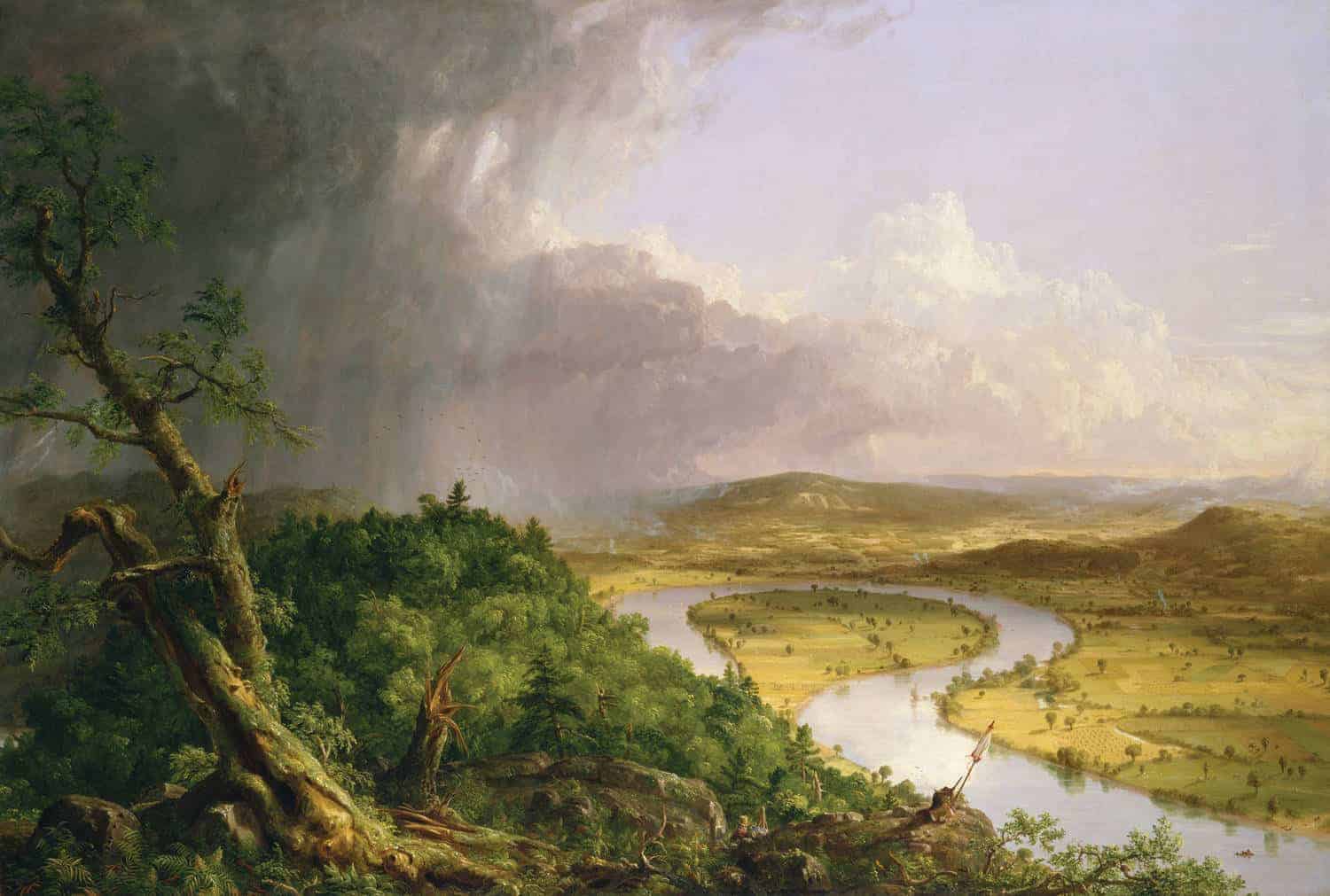
afterwards a Thunderstorm (1836)
Wordsworth and Coleridge left the urban center for the Lake Commune. In America, transcendentalists such as Emerson or Thoreau did the same. Thoreau went out in the wilderness to Walden Pond to write Walden in 1854.
They discovered the American identity : the civilization was European. There is a kind of individualism that refuses every kind of moral convention (who y'all really are) and pantheism (belief that Nature is divine and has a soul).
The expression of personal feelings, free energy and passion
Nature was non only peaceful and meditative but also stormy, tempestuous and too big for homo (sublime).
In Shelley's Ode to the W Current of air, the poet starts past identifying himself with the current of air : he wants to have the same power and the aforementioned liberty. Equally such, it tin be considered a political verse form. The "w wind" is the wind from America, from the Revolution.
The romantic world is a dynamic world of change. When there is beauty, it's always ephemeral. What creates the changes are the elemental forces (tempest, power, etc).
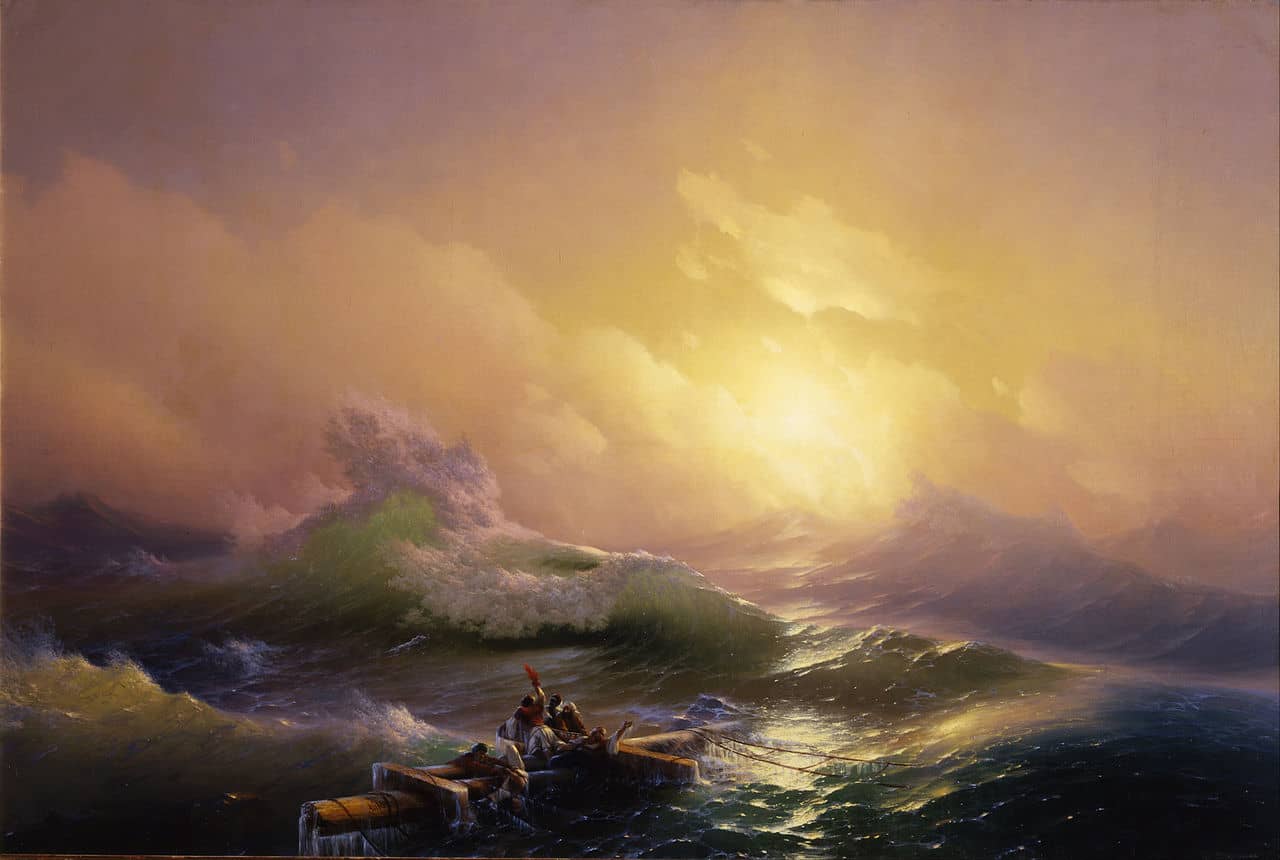
Energy can come from human beings also. Romanticism is the emphasis of feelings, passions and intuitions. It differs from the 18th century, which was based on reason and reflection.
Reason is universal, everyone uses the same logic : it is non personal. On the other hand, feelings, passion and intuition are what make people dissimilar from each other; it is very individualistic and selfish.
Passion is i of the dynamic elements of romanticism, it's a factor of change for the individual and a gene of historical change as Hegel in one case said "nothing great was accomplished in history without passion".
Passion is too extremely irresolute : nothing is closer to love than hate. Information technology alternates between exaltation and melancholy, betwixt nostalgia and optimism.
I am certain of nothing but of the holiness of the heart's affections and the truth of imagination.
John Keats
The romantic vision of beloved is best because intense when incommunicable : destiny, decease, social differences – as in Romeo and Juliet.
Keats' Isabella or the Pot of Basil happens in the Middle Ages in Italia. The lover is killed by Isabella'southward brothers. She digs his grave, cuts his head and hides it in a pot of basil with a blossom in information technology. As she cries everyday, it turns to a beautiful flower. It is Bocaccio's story and Stendhal'south Le Rouge et le Noir : a connection between dear (Eros) and death (Thanatos).
According to Nietsche, passion is "beyond good and evil", it does not care about morality.
A dualistic globe
Contrasts, dichotomies tin be seen on all levels between reason and emotion, cute and sublime, reality and imagination.
Dialectics are the dynamic principle behind everything and could be seen equally a rational monism (the antonym of "pluralism") with the religious revival and the visionary style. E.1000 : Wuthering Heights by Emily Brontë, Jane Eyre by Charlotte Brontë, Anne Grey by Anne Brontë.
Wuthering Heights takes place in Yorkshire moors. Catherine Earnshaw hesitates between Heathcliff and Edgar Linton. She chooses Edgar but Heathcliff comes back rich. In that location is a conflict between what men represent and what places stand for. Information technology'due south the conflict of "the children of calm, the children of the storm".
The dualism is a cosmic matter between at-home and quietness, storm and passion. It's the idea of homo duplex : man is double in a "double simultaneous postulation".
A rediscovery of history and exoticism
In that location is a rediscovery of history and exoticism through local color : few details to bear witness you are not at home (for instance, if you write nigh Asia, add some geishas in kimonos).
With romanticism, in that location is an outburst of cultural nationalism : German romanticism was a flowering of colloquial literatures. The vernacular is the language spoken by the people; it's unlike from the language spoken by the cultural elite (French, Latin). It was good enough to produce practiced literature. In that location was also a going back to folklore, legends, and fairy tales.
Wordsworth and Coleridge both wrote lyrical ballads in 1798. In The Rhyme of the Ancient Mariner, Coleridge worked on the supernatural and tells the story of a mariner who killed an boundness, which is a very bad omen for mariners : they are all doomed.
In The Idiot Boy, Wordsworth dealt with the ordinary life and tells the story of a woman who needs medicine for her child. She sends the idiot boy. His aim was to correspond the essential passions of human nature, to use simple linguistic communication, "the select of a language, really used past men". He abandoned the artificiality of poetic diction and the political dimension criticized by many people.
Wordsworth also wrote "chat poems" such equally Frost as midnight: bare poesy monologues addressing the listener as in a conversation. The listener is in fact the reader.
Regional poetry is another style to apply the colloquial : vernacular in Scotland is different from the colloquial in Due south England. Run into Walter Scott and Robert Burns.
Walter Scott invented the historical novel with Waverley (1814) and Ivanhoe (1819). He gave a sense of history with accurate details and characters' destinies influenced by historical faces. The plot tells a clash of values, of choices made in a crucial moment by a young and romantic man, through the arcadian image of a united nation. Scott tried to show reconciliation between idealism and reality.
In the Us, James Fenimore Cooper's The Last of the Mohicans (1826) tells nigh the disharmonize between France and Britain in the American colonies. The image of the Native American is that of a noble barbarous, yet a "vanishing Indian" because of the progress of the American civilization.
Artful dimension
Run into Todorov's Théories du Symbole (1977). Romanticism emphasizes imagination (equally opposed to the 18th century).
Before, art was imitation and mimesis (cf. Aristotle). At that place was a process of selection of things that were worth representing and a correction of nature co-ordinate to the image of beauty you had in mind (harmony in parts and whole).
On the other manus, with romanticism, fine art is cosmos; it's an autonomous whole. It does not imitate nature just recreates it. It is not a mirror but a different reality. This parallel world is based on the necessary artistic relations between the different organic parts.
Thus, it is useless, in that location is no purpose except of recreating reality. It is complimentary, autonomous, different earlier when it was made to instruct and entertain with a moral quality. At that place is no morality in fine art for the romantics.
Similar nature, a work of art is an organic totality in course and meaning. The faculty it creates is imagination. Coleridge defined fancy and imagination in The Biographia Literaria, one of his main critical studies.
Imagination is an artistic and secondary imagination. It's the principle of unity in a piece of work of art and assimilates into a unifying vision. Main imagination is the basis of perception and God-like quality:
The IMAGINATION then, I consider either as primary, or secondary. The primary IMAGINATION I hold to exist the living Power and prime Agent of all human Perception, and as a repetition in the finite mind of the eternal act of creation in the infinite I AM. The secondary Imagination I consider as an echo of the former, co-existing with the conscious will, nonetheless nevertheless every bit identical with the primary in the kind of its agency, and differing just in degree, and in the manner of operation. It dissolves, diffuses, dissipates, in order to recreate; or where this process is rendered impossible, yet however at all events it struggles to idealise and unify. Information technology is essentially vital, even as all objects (as objects) are essentially fixed and dead.
Fancy is associational logic, y'all do not create but acquaintance ideas :
FANCY, on the contrary, has no other counters to play with, but fixities and definites. The Fancy is indeed no other than a mode of Memory emancipated from the order of time and infinite; while information technology is blended with, and modified by that empirical phenomenon of the will, which nosotros express by the word Selection. Simply equally with the ordinary retention the Fancy must receive all its materials ready made from the police force of clan.
In Coleridge'south Kubla Khan (1816), there'due south a dissimilarity between microcosm and macrocosm : the union of contraries makes a synthetic whole thank you to symbols, polysemy and allegories.
In Herman Melville'due south Moby Dick (1851), the white whale is an albinos and there is an opposition between nature and human (captain Ahab) showing the irreducible forces of nature.
The image of the artist can take several forms. He tin be like a God, a creator but information technology comes with strings attached such as the problem of transgression or curse.
If yous are like a God, you lot're likely to get punished for your hubris or your disobedience to the catholic laws, simply similar Prometheus. The creative person can also adopt the image of the "poète maudit".
Source: https://www.skyminds.net/the-19th-century-romanticism-in-art-and-literature/
0 Response to "Can Art and Poetry Be Used to Change the Evils Within a Society Romantasism"
Post a Comment