in 1992, the worst civil disturbance in los angeles history occurred in response to what event?
| Watts riots | |
|---|---|
| Part of the ghetto riots | |
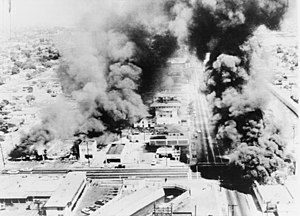 Burning buildings during the riots | |
| Appointment | August 11–16, 1965 |
| Location | Watts, Los Angeles |
| Goals | To cease mistreatment by the police and to stop bigotry in housing, employment and schooling systems |
| Methods | Widespread rioting, looting, assault, arson, protests, firefights, property damage |
| Casualties | |
| Death(s) | 34 |
| Injuries | 1,032 |
| Arrested | 3,438 |
The Watts riots, sometimes referred to as the Watts Rebellion or Watts Insurgence,[1] took identify in the Watts neighborhood and its surrounding areas of Los Angeles from August eleven to sixteen, 1965.
On August xi, 1965, Marquette Frye, a 21-year-old African American man, was pulled over for drunken driving.[two] [3] [four] After he failed a field sobriety exam, officers attempted to abort him. Marquette resisted arrest, with assistance from his mother, Rena Frye; a concrete confrontation ensued in which Marquette was struck in the face with a baton. Meanwhile, a oversupply of onlookers had gathered.[2] Rumors spread that the police had kicked a pregnant woman who was nowadays at the scene. Six days of civil unrest followed, motivated in function by allegations of police force corruption.[3] Almost 14,000 members of the California Army National Guard[5] helped suppress the disturbance, which resulted in 34 deaths,[vi] as well as over $40 one thousand thousand in property damage.[7] [8] It was the urban center's worst unrest until the Rodney King riots of 1992.
Background [edit]
In the Great Migration of 1915–1940, major populations of African Americans moved to Northeastern and Midwestern cities such as Detroit, Chicago, St. Louis, Cincinnati, Philadelphia, Boston, and New York City to pursue jobs in newly established manufacturing industries; to cement better educational and social opportunities; and to flee racial segregation, Jim Crow laws, violence and racial bigotry in the Southern states. This wave of migration largely bypassed Los Angeles.[ix]
In the 1940s, in the Second Great Migration, black workers and families migrated to the W Coast in large numbers, in response to defense manufacture recruitment efforts at the starting time of Earth State of war II. President Franklin D. Roosevelt issued Executive Order 8802 directing defence contractors not to discriminate in hiring or promotions, opening up new opportunities for minorities. The black population in Los Angeles dramatically rose from approximately 63,700 in 1940 to about 350,000 in 1965, rising from 4% of L.A.'southward population to xiv%.[x] [11]
Residential segregation [edit]
Los Angeles had racially restrictive covenants that prevented specific minorities from renting and buying property in certain areas, fifty-fifty long after the courts ruled such practices illegal in 1948 and the Ceremonious Rights Act of 1964 was passed. At the showtime of the 20th century, Los Angeles was geographically divided by ethnicity, every bit demographics were being altered by the rapid migration from the Philippines (U.S. unincorporated territory at the time) and immigration from Mexico, Nihon, Korea, and Southern and Eastern Europe. In the 1910s, the city was already 80% covered by racially restrictive covenants in real estate.[12] Past the 1940s, 95% of Los Angeles and southern California housing was off-limits to sure minorities.[thirteen] [fourteen] Minorities who had served in World War II or worked in Fifty.A.'due south defense industries returned to face increasing patterns of discrimination in housing. In addition, they found themselves excluded from the suburbs and restricted to housing in East or South Los Angeles, which includes the Watts neighborhood and Compton. Such real-estate practices severely restricted educational and economical opportunities available to the minority community.[13]
Following the United states of america entry into Globe War II afterwards the attack on Pearl Harbor, the federal government removed and interned seventy,000 Japanese-Americans from Los Angeles, leaving empty spaces in predominantly Japanese-endemic areas. This further bolstered the migration of black residents into the metropolis during the 2nd Great Migration to occupy the vacated spaces, such as Picayune Tokyo. Equally a result, housing in South Los Angeles became increasingly scarce, overwhelming the already established communities and providing opportunities for real estate developers. Davenport Builders, for instance, was a large programmer who responded to the need, with an eye on undeveloped state in Compton. What was originally a mostly white neighborhood in the 1940s increasingly became an African-American, middle-class dream in which blue-collar laborers could savour bourgeoisie abroad from the slums.[13]
In the post-Earth State of war Ii era, suburbs in the Los Angeles area grew explosively as blackness residents too wanted to live in peaceful white neighborhoods. In a thinly-veiled attempt to sustain their way of life and maintain the general peace and prosperity, most of these suburbs barred black people, using a variety of methods. White heart-class people in neighborhoods bordering black districts moved en masse to the suburbs, where newer housing was bachelor. The spread of African Americans throughout urban Los Angeles was accomplished in big part through blockbusting, a technique whereby existent estate speculators would buy a home on an all-white street, sell or rent it to a black family unit, and then purchase up the remaining homes from Caucasians at cut-rate prices, then sell them to housing-hungry black families at hefty profits.[15]
The Rumford Fair Housing Human activity, designed to remedy residential segregation, was overturned by Proposition xiv in 1964, which was sponsored by the California existent estate industry, and supported by a majority of white voters. Psychiatrist and civil rights activist Alvin Poussaint considered Suggestion xiv to exist i of the causes of blackness rebellion in Watts.[sixteen]
In 1950, William H. Parker was appointed and sworn in every bit Los Angeles Primary of Police force. Subsequently a major scandal chosen Bloody Christmas of 1951, Parker pushed for more independence from political pressures that would enable him to create a more than professionalized law. The public supported him and voted for charter changes that isolated the police department from the rest of the metropolis government. In the 1960s, the LAPD was promoted[ by whom? ] every bit one of the best police forces in the globe.[ commendation needed ]
Despite its reform and having a professionalized, military-like police force strength, William Parker's LAPD faced repeated criticism from the city'due south Latino and black residents for police force brutality—resulting from his recruiting of officers from the South with potent anti-black and anti-Latino attitudes. Chief Parker coined the term "thin blue line", representing the police every bit holding down pervasive criminal offence.[17]
Resentment of such longstanding racial injustices is cited equally reason why Watts' African-American population exploded on Baronial 11, 1965, in what would go the Watts Riots.[18]
Inciting incident [edit]
On the evening of Wednesday, Baronial 11, 1965, 21-year-quondam Marquette Frye, an African-American man driving his mother's 1955 Buick while drunk, was pulled over by California Highway Patrol motorcycle officer Lee Minikus for alleged reckless driving.[4] After Frye failed a field sobriety test, Minikus placed him nether arrest and radioed for his vehicle to be impounded.[19] Marquette's blood brother, Ronald, a passenger in the vehicle, walked to their business firm nearby, bringing their mother, Rena Cost, back with him to the scene of the abort.
When Rena Price reached the intersection of Avalon Boulevard and 116th Street that evening, she scolded Frye almost drinking and driving as he recalled in a 1985 interview with the Orlando Watch.[20] Still, the situation quickly escalated: someone shoved Price, Frye was struck, Cost jumped an officer, and another officeholder pulled out a shotgun. Backup police force officers attempted to arrest Frye by using concrete force to subdue him. After community members reported that police had roughed upward Frye and shared a rumor they had kicked a pregnant woman, angry mobs formed.[21] [22] As the situation intensified, growing crowds of local residents watching the exchange began yelling and throwing objects at the police officers.[23] [ folio needed ] Frye's mother and brother fought with the officers and eventually were arrested forth with Marquette Frye.[24] [ folio needed ] [25] [ page needed ] [ dead link ] [8]
After the arrests of Price and her sons the Frye brothers, the crowd continued to grow along Avalon Boulevard. Police came to the scene to break up the oversupply several times that night, but were attacked when people threw rocks and chunks of concrete.[26] A 46-square-mile (120 km2) swath of Los Angeles was transformed into a gainsay zone during the ensuing 6 days.[22]
Riot begins [edit]

Police force abort a man during the riots on August 12
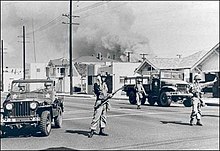
After a night of increasing unrest, law and local blackness community leaders held a community meeting on Th, August 12, to discuss an action plan and to urge calm. The coming together failed. Later that day, Chief Parker called for the assistance of the California Army National Guard.[27] Master Parker believed the riots resembled an insurgency, compared it to fighting the Viet Cong, and decreed a "paramilitary" response to the disorder. Governor Pat Brown declared that police enforcement was confronting "guerrillas fighting with gangsters".[6]
The rioting intensified, and on Fri, Baronial 13, nigh two,300 National Guardsmen joined the constabulary in trying to maintain society on the streets. Sergeant Ben Dunn said: "The streets of Watts resembled an all-out war zone in some far-off foreign country, it diameter no resemblance to the United states of America."[28] [ page needed ] [29] The showtime riot-related death occurred on the dark of August 13, when a black civilian was killed in the crossfire during a shootout between the police and rioters. Over the next few days, rioting had then spread throughout other areas, including Pasadena, Pacoima, Monrovia, Long Beach, and fifty-fifty as far as San Diego, although they were very small in comparison to Watts. Near 200 Guardsmen and the LAPD were sent to assist the Long Beach Police Department (LBPD) in controlling the unruly oversupply.
Past nightfall on Saturday, 16,000 constabulary enforcement personnel had been mobilized and patrolled the metropolis.[6] Blockades were established, and alarm signs were posted throughout the anarchism zones threatening the employ of deadly force (one sign warned residents to "Turn left or get shot"). Angered over the police response, residents of Watts engaged in a total-scale battle against the showtime responders. Rioters tore upwardly sidewalks and bricks to hurl at Guardsmen and police, and to boom their vehicles.[6] Those actively participating in the riots started physical fights with police, blocked Los Angeles Fire Department (LAFD) firefighters from using fire hoses on protesters and called-for buildings, or stopped and vanquish white motorists while yelling racial slurs in the area.[ citation needed ] Arson and looting were largely confined to local white-owned stores and businesses that were said to take caused resentment in the neighborhood due to low wages and high prices for local workers.[thirty]
To quell the riots, Main Parker initiated a policy of mass arrest.[6] Post-obit the deployment of National Guardsmen, a curfew was declared for a vast region of South Central Los Angeles.[31] In add-on to the Guardsmen, 934 LAPD officers and 718 officers from the Los Angeles County Sheriff's Department (LASD) were deployed during the rioting.[27] Watts and all black-bulk areas in Los Angeles were put under the curfew. All residents outside of their homes in the affected areas after 8:00p.m. were subject to abort. Eventually, nigh 3,500 people were arrested, primarily for curfew violations. By the morning of Sunday, August 15, the riots had largely been quelled.[6]
Over the course of half-dozen days, between 31,000 and 35,000 adults participated in the riots. Around 70,000 people were "sympathetic, but not active."[26] Over the six days, in that location were 34 deaths,[32] [33] i,032 injuries,[32] [34] iii,438 arrests,[32] [35] and over $forty one thousand thousand in property impairment.[32] Many white Americans were fearful of the breakdown of social order in Watts, especially since white motorists were being pulled over by rioters in nearby areas and assaulted.[36] Many in the blackness community, however, believed the rioters were taking function in an "uprising against an oppressive system."[26] In a 1966 essay, black civil rights activist Bayard Rustin wrote:
The whole point of the outbreak in Watts was that it marked the first major rebellion of Negroes against their own masochism and was carried on with the limited purpose of asserting that they would no longer quietly submit to the deprivation of slum life.[37]
Despite allegations that "criminal elements" were responsible for the riots, the vast bulk of those arrested had no prior criminal record.[half dozen] Simply three sworn personnel were killed in the riots: an LAFD fireman was struck when a wall of a fire-weakened structure fell on him while fighting fires in a shop,[38] an LASD deputy was shot when another deputy's shotgun was discharged in a struggle with rioters,[39] and an LBPD officeholder was shot past some other police officer's gun that was discharged during a scuffle with rioters.[40] 23 out of the 34 people killed in the riots were shot past LAPD officers or National Guardsmen.[41]
Later on the riots [edit]
Debate rose speedily over what had taken place in Watts, as the expanse was known to be nether a great deal of racial and social tension. Reactions and reasoning about the riots greatly varied based on the perspectives of those afflicted past and participating in the riots' chaos.
National civil rights leader Rev. Dr. Martin Luther King Jr. spoke two days subsequently the riots happened in Watts. The riots were partly a response to Proposition 14, a constitutional amendment sponsored by the California Real Manor Clan and passed that had in consequence repealed the Rumford Fair Housing Human action.[42] In 1966, the California Supreme Courtroom reinstated the Rumford Fair Housing Human activity in the Reitman v. Mulkey case (a decision affirmed by the U.S. Supreme Court the post-obit year), declaring the subpoena to violate the US constitution and laws.
A diversity of opinions and explanations were published. Public opinion polls studied in the few years after the riot showed that a majority believed the riots were linked to communist groups who were active in the area protesting high unemployment rates and racial discrimination.[43] Those opinions concerning racism and discrimination were expressed three years subsequently hearings conducted by a committee of the U.S. Commission on Civil Rights took place in Los Angeles to assess the condition of relations between the law forcefulness and minorities. These hearings were also intended to make a ruling on the discrimination case against the police for their declared mistreatment of members of the Nation of Islam.[43] These different arguments and opinions are often cited in continuing debates over the underlying causes of the Watts riots.[30]
White flying [edit]
After the Watts Riots, white families left surrounding nearby suburbs like Compton, Huntington Park, and South Gate in large numbers, leading to significant demographic and economic changes of these suburbs.[44] Although the unrest did non reach these suburbs during the riots, many white residents in Huntington Park, for instance, left the area.[45]
McCone Commission [edit]
A committee under Governor Pat Brown investigated the riots, known as the McCone Commission, and headed by former CIA director John A. McCone. Other commission members included Warren Christopher, a Los Angeles attorney who would be the committee's vice chairman, Earl C. Broady, Los Angeles Superior Court gauge; Asa V. Call, former president of the State Chamber of Commerce; Rev. Charles Casassa, president of Loyola University of Los Angeles; the Rev. James E. Jones of Westminster Presbyterian Church building and member of the Los Angeles Board of Education; Mrs. Robert Grand. Newmann, a League of Women Voters leader; and Dr. Sherman K. Mellinkoff, dean of the School of Medicine at UCLA. The simply two African American members were Jones and Broady.[46]
The commission released a 101-folio report on December 2, 1965, entitled Violence in the City—An End or a Beginning?: A Report by the Governor'due south Commission on the Los Angeles Riots, 1965.[47]
The McCone Committee identified the root causes of the riots to be high unemployment, poor schools, and related junior living conditions that were endured by African Americans in Watts. Recommendations for addressing these problems included "emergency literacy and preschool programs, improved law-customs ties, increased depression-income housing, more job-grooming projects, upgraded health-care services, more efficient public transportation, and many more than." About of these recommendations were never implemented.[48]
Backwash [edit]
![[icon]](https://upload.wikimedia.org/wikipedia/commons/thumb/1/1c/Wiki_letter_w_cropped.svg/20px-Wiki_letter_w_cropped.svg.png) | This section needs expansion. You can help past calculation to it. (February 2019) |
Marquette Frye died of pneumonia on Dec xx, 1986, at age 42.[49] His mother, Rena Price, died on June 10, 2013, at age 97.[50] She never recovered the impounded 1955 Buick which her son had been driving because the storage fees exceeded the car'southward value.[51]
Cultural references [edit]
- The 1972 music festival at Los Angeles Coliseum known every bit Wattstax, and its follow-up 1973 documentary film, were created to commemorate the 7th anniversary of the riots.[52]
- The Hughes brothers flick Menace II Club (1993) opens with images taken from the riots of 1965. The entire film is fix in Watts from the 1970s to the 1990s.
- Frank Zappa wrote a lyrical commentary inspired by the Watts riots, entitled "Trouble Every Day". It contains such lines every bit "Wednesday I watched the riot / Seen the cops out on the street / Watched 'em throwin' rocks and stuff /And chokin' in the heat". The vocal was released on his debut album Freak Out! (with the original Mothers of Invention), and later slightly rewritten as "More Trouble Every Twenty-four hours", available on Roxy and Elsewhere and The All-time Ring You Never Heard In Your Life.
- Phil Ochs' 1965 song "In the Estrus of the Summer", nearly famously recorded by Judy Collins, was a chronicle of the Watts Riots.
- Curt Gentry'due south 1968 novel, The Last Days of the Late, Great State of California, dissected the riots in detail in a fact-based semi-documentary tone.
- Charles Bukowski mentioned the Watts riots in his verse form "Who in the hell is Tom Jones?" and briefly mentions the events towards the stop of Post Office.
- The 1990 film Heat Wave depicts the Watts riots from the perspective of journalist Bob Richardson as a resident of Watts and a reporter for the Los Angeles Times.
- The 1994 film In that location Goes My Baby tells the story of a group of high school seniors during the riots.
- The producers of the Planet of the Apes franchise stated that the riots inspired the ape uprising featured in the film Conquest of the Planet of the Apes.[53]
- In "Black on White on Fire", an episode of the television set series Quantum Leap which aired Nov 9, 1990, Sam Beckett shifts into the trunk of a black medical student who is engaged to a white woman while living in Watts during the riots.
- Scenes in "Burn, Baby, Burn, Baby, burn, fire, bird", an episode of the TV series Dark Skies, are set in Los Angeles during the riots.
- The movie C.S.A.: The Confederate States of America mentions the Watts riots as a slave rebellion rather than a riot.
- Walter Mosley'due south novel Niggling Scarlet, in which Mosley'due south lead grapheme Like shooting fish in a barrel Rawlins is asked by police to investigate a racially charged murder in neighborhoods where white investigators are unwelcome, takes place in the aftermath of the Watts riots.
- The riots are depicted in the third issue of the Before Watchmen: Comedian comic book.
- The riots are referred to in the 2000 picture Remember the Titans. An Alexandria, Virginia schoolhouse lath representative tells head football game passenger vehicle Pecker Yoast that he would be replaced past Herman Boone, an African American coach from North Carolina because the school lath feared that otherwise, Alexandria would "...burn down upwardly like Watts".
- In Chapter 9 of A Song Flung Up To Heaven, the sixth volume of Maya Angelou's autobiography, Angelou gives an account of the riots. She had a job in the neighborhood at the time and was there every bit they played out.
- Joseph Wambaugh'south novel The New Centurions (1971), and the 1972 movie adaptation of the aforementioned name, are partially fix during the Watts riots.
- The arrest of the Frye brothers and the riots are referred to by the grapheme George Hutchence in the second volume of the comics miniseries Jupiter'south Circle, as an instance of class struggle.[54]
- O.J.: Made in America, 1st episode
- The riots are mentioned in Richard Powers' novel The Fourth dimension of Our Singing (2003).
- The riots are mentioned in Michael Connelly's lost chapter of his 1999 novel Angels Flying, besides as his 2005 novel The Closers.
- In comedian Christopher Titus' 2009 comedy special "Love is Evol", Titus mentions that his begetter, Ken Titus was a California National Guardsman during the Watts Riots and dedicated liquor stores from rock-throwing rioters.
- The titular song from American hip hop grouping Cypress Loma's 2010 album Rise Up opens upward with the line "Not since the Watts Anarchism of 1965, has the urban center seem and so out of command. Los Angeles is withal on border".
- The riots are occurring in episodes 5 and 6 of the TV show I Am the Nighttime.
- The riots are mentioned in the 2020 novel The Vanishing One-half by Brit Bennett
See also [edit]
- 1992 Los Angeles riots
- Cloward–Piven strategy, derived from the riots in the 1960s
- History of African-Americans in Los Angeles
- List of ethnic riots
- Listing of incidents of ceremonious unrest in the United States
- Billy G. Mills (born 1929), Los Angeles City Councilman, 1963–74, investigated the Watts riots
- Charles A. Ott Jr. (1920–2006), United States Army and California Army National Guard Major General who commanded National Guard soldiers in Los Angeles during the effect
- Urban disuse
- Urban riots
- Watts Prophets
- Wattstax
- Zoot Suit Riots
Footnotes [edit]
- ^ "Watts Rebellion (Los Angeles) | The Martin Luther King, Jr., Research and Pedagogy Institute". kinginstitute.stanford.edu. June 12, 2017. Retrieved October 22, 2018.
- ^ a b Queally, James (July 29, 2015). "Watts Riots: Traffic terminate was the spark that ignited days of devastation in L.A." Los Angeles Times . Retrieved May 31, 2020.
- ^ a b "How Legacy Of The Watts Riot Consumed, Ruined Man's Life". tribunedigital-orlandosentinel . Retrieved March 2, 2018.
- ^ a b Dawsey, Darrell (August nineteen, 1990). "To CHP Officer Who Sparked Riots, It Was Just Another Abort". Los Angeles Times.
- ^ University, © Stanford; Stanford; California 94305 (June 12, 2017). "Watts Rebellion (Los Angeles)". The Martin Luther King Jr., Research and Education Institute . Retrieved June half-dozen, 2020.
- ^ a b c d due east f g Hinton, Elizabeth (2016). From the State of war on Poverty to the War on Crime: The Making of Mass Incarceration in America. Harvard University Press. pp. 68–72. ISBN9780674737235.
- ^ Joshua, Flower; Martin, Waldo (2016). Black Against Empire: The History And Politics Of The Black Panther Party. Academy of California Printing. p. 30.
- ^ a b Szymanski, Michael (August five, 1990). "How Legacy of the Watts Riot Consumed, Ruined Human being's Life". Orlando Sentinel . Retrieved June 22, 2013.
- ^ McReynolds, Devon (February 14, 2016). "Photos: Black Los Angeles During The First 'Keen Migration'". LAist . Retrieved November xiii, 2020.
- ^ "The Great Migration: Creating a New Black Identity in Los Angeles", KCET
- ^ "Population", LA Annual
- ^ Taylor, Dorceta (2014). Toxic Communities: Environmental Racism, Industrial Pollution, and Residential Mobility. NYU Press. p. 202. ISBN9781479861620.
- ^ a b c Bernstein, Shana (2010). Bridges of Reform: Interracial Ceremonious Rights Activism in Twentieth-Century Los Angeles. Oxford University Press. pp. 107–109. ISBN9780199715893.
- ^ Michael Dear; H. Eric Schockman & Greg Hise (1996). Rethinking Los Angeles. SAGE. p. twoscore. ISBN9780803972872.
- ^ Gaspaire, Brent (January vii, 2013). "Blockbusting". Retrieved November 13, 2020.
- ^ Theoharis, Jeanne (2006). The Black Power Move: Rethinking the Civil Rights-Blackness Power Era. (New York: Routledge), p. 47-49. Archived at Google Books. Retrieved February iv, 2016.
- ^ Shaw, David (May 25, 2014). "Main Parker Molded LAPD Image--Then Came the '60s : Police force: Press treated officers as heroes until social upheaval prompted skepticism and confrontation". Los Angeles Times . Retrieved September 21, 2014.
- ^ Watts Riots (August 1965) | The Black Past: Remembered and Reclaimed. The Black Past (August 11, 1965).
- ^ Cohen, Jerry; Potato, William S. (July 15, 1966). "Burn, Baby, Burn down!" Life. Archived at Google Books. Retrieved February four, 2016.
- ^ Szymanski, Michael (August v, 1990). "How Legacy of the Watts Riot Consumed, Ruined Man's Life". Orlando Scout. Archived from the original on December vi, 2013. Retrieved June 22, 2013.
- ^ Dawsey, Darrell (August 19, 1990). "To CHP Officer Who Sparked Riots, It Was Just Another Arrest". Los Angeles Times . Retrieved November 23, 2011.
- ^ a b Woo, Elaine (June 22, 2013). "Rena Price dies at 97; her and son'southward arrests sparked Watts riots". Los Angeles Times . Retrieved June 22, 2013.
- ^ Abu-Lughod, Janet L. Race, Space, and Riots in Chicago, New York, and Los Angeles. New York: Oxford University Press, 2007.
- ^ Walker, Yvette (2008). Encyclopedia of African American History, 1896 to the Present: From the Age of Segregation to the Twenty-starting time Century. Oxford University Press.
- ^ Alonso, Alex A. (1998). Rebuilding Los Angeles: A Lesson of Customs Reconstruction (PDF). Los Angeles: University of Southern California.
- ^ a b c Barnhill, John H. (2011). "Watts Riots (1965)". In Danver, Steven L. (ed.). Revolts, Protests, Demonstrations, and Rebellions in American History, Volume iii. ABC-CLIO.
- ^ a b "Violence in the City: An End or a Beginning?". Retrieved January iii, 2012.
- ^ Siegel, Fred (January 28, 2014). The Revolt Confronting the Masses: How Liberalism Has Undermined the Middle Grade. Encounter Books. ISBN9781594036989.
- ^ Troy, Tevi (2016). Shall We Wake the President?: Two Centuries of Disaster Management from the Oval Role. Rowman and Littlefield. p. 156. ISBN9781493024650.
- ^ a b Oberschall, Anthony (1968). "The Los Angeles Riot of August 1965". Social Bug. 15 (3): 322–341. doi:ten.2307/799788. JSTOR 799788.
- ^ "A Report Apropos the California National Guard's Role in Suppressing the Los Angeles Riot, Baronial 1965" (PDF).
- ^ a b c d "The Watts Riots of 1965, in a Los Angeles newspaper... ". Timothy Hughes: Rare & Early Newspapers. Retrieved Feb 4, 2016.
- ^ Reitman, Valerie; Landsberg, Mitchell (Baronial eleven, 2005). "Watts Riots, xl Years Later". Los Angeles Times.
- ^ "Watts Riot begins - August eleven, 1965". This Mean solar day in History. History. Retrieved February 3, 2016.
- ^ "Finding assist for the Watts Riots records 0084". Online Annal of California. Retrieved Feb three, 2016.
- ^ Queally, James (July 29, 2015). "Watts Riots: Traffic stop was the spark that ignited days of destruction in L.A.", Los Angeles Times.
- ^ Rustin, Bayard (March 1966). "The Watts". Commentary Mag . Retrieved January three, 2012.
- ^ "Fire fighter Warren E. Tilson, Los Angeles Fire Department". Los Angeles Fire Department Historical Annal.
- ^ "Deputy Sheriff Ronald East. Ludlow". Officer Downwardly Memorial Page.
- ^ "Constabulary Officeholder Richard R. LeFebvre". Officer Down Memorial Page.
- ^ Jerkins, Morgan (August 3, 2020). "A Haunting Story Behind the 1965 Watts Riots". Time . Retrieved Nov xiv, 2020.
- ^ Tracy Domingo, Miracle at Malibu Materialized, Graphic, November 14, 2002
- ^ a b Jeffries, Vincent & Ransford, H. Edward. "Interracial Social Contact and Center-Class White Reaction to the Watts Riot". Social Problems xvi.3 (1969): 312–324.
- ^ Ramirez, Aron (July x, 2019). "On Race, Housing, and Confronting History". The Downey Patriot . Retrieved August 23, 2020.
- ^ Holguin, Rick; Ramos, George (April 7, 1990). "Cultures Follow Separate Paths in Huntington Park". Los Angeles Times . Retrieved August 23, 2020.
- ^ "King and Yorty Feud Over Causes of Roiting in LA". Detroit Costless Press at Newspapers.com. August 20, 1965. p. 17. Retrieved July 3, 2021.
- ^ Violence in the City—An End or a First?: A Report by the Governor'south Commission on the Los Angeles Riots, 1965. University of Southern California. Retrieved August 21, 2014.
- ^ Dawsey, Darrell (July 8, 1990). "25 Years Later the Watts Riots : McCone Commission'due south Recommendations Have Gone Unheeded". Los Angeles Times . Retrieved Nov 22, 2011.
- ^ "Marquette Frye Dead; 'Man Who Began ///..Riot". The New York Times. Dec 25, 1986. Retrieved June 23, 2013.
- ^ "Rena Price, adult female whose abort sparked Watts riots, dies at 97".
- ^ Woo, Elaine (June 22, 2013). "Rena Toll dies at 97; her and son's arrests sparked Watts riots". Los Angeles Times . Retrieved June 22, 2013.
- ^ Maycock, James (July 20, 2002). "Loud and proud". The Guardian – via www.theguardian.com.
- ^ Abramovich, Alex (July 20, 2001). "The Apes of Wrath". Slate Magazine. Slate.com. Retrieved August thirty, 2011.
- ^ Millar, Marking (west), Torres, Wilfredo; Gianfelice, Davide (a).Jupiter's Circumvolve v2, two (December 2015), Image Comics
Further reading [edit]
- Cohen, Jerry and William S. Spud, Burn, Babe, Burn down! The Los Angeles Race Riot, August 1965, New York: Dutton, 1966.
- Conot, Robert, Rivers of Blood, Years of Darkness, New York: Bantam, 1967.
- Davis, Mike; Wiener, Jon (2020). Gear up the Night on Burn: L.A. in the Sixties. New York: Verso Books.
- Guy Debord, Decline and Fall of the Spectacle-Article Economy, 1965. A situationist estimation of the riots
- Horne, Gerald, Fire This Time: The Watts Insurgence and the 1960s, Charlottesville: University of Virginia Printing, 1995.
- Thomas Pynchon, "A Journey into the Mind of Watts", 1966. full text
- David O' Sears, The politics of violence: The new urban Blacks and the Watts anarchism
- Clayton D. Clingan, Watts Riots
- Paul Bullock, Watts: The Aftermath. New York: Grove Press, Inc., 1969.
- Johny Otis, Heed to the Lambs. New York: W.Westward. Norton and Co. 1968.
External links [edit]
- A Huey P. Newton Story – Times - Watts Riots at PBS
- Watts – The Standard Bearer – Watts and the riots of the 1960s.
Source: https://en.wikipedia.org/wiki/Watts_Riots
0 Response to "in 1992, the worst civil disturbance in los angeles history occurred in response to what event?"
Post a Comment